
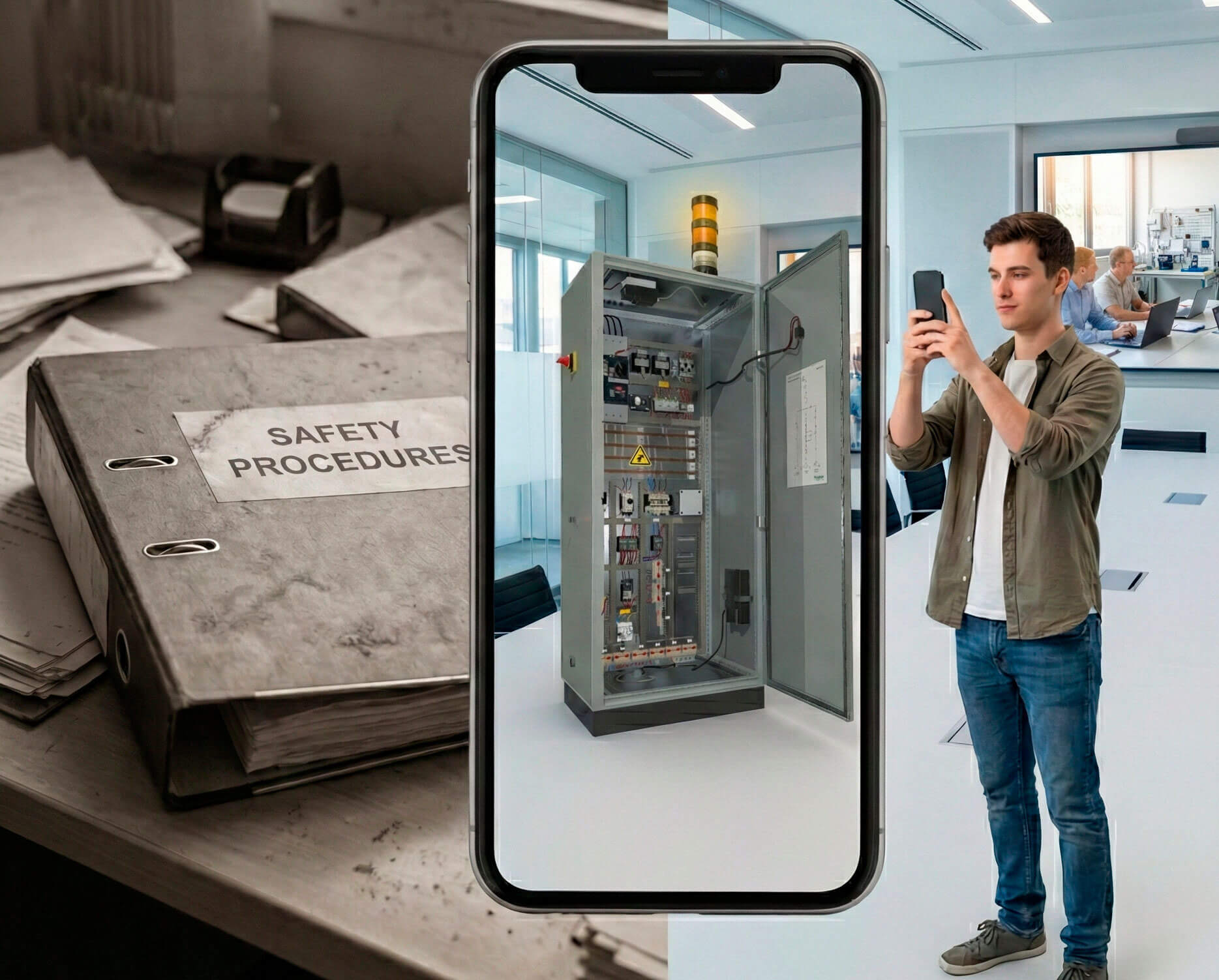
A binder full of safety procedures is no longer a protocol, it’s a liability.
Industrial safety is under pressure from two converging forces. First, economics: workplace injuries cost the global economy more than $170 billion every year. Second, a workforce shift: Gen Z now represents over 27% of the global workforce, bringing digital-first expectations directly onto the job site.
Together, these forces are widening the Expectation Gap between how safety is taught and how work is actually performed, and they are fueling a persistent Near-Miss Crisis that most organizations struggle to see, let alone solve.
To move forward, safety must evolve beyond compliance. What modern operations need is hazard intuition: the ability for workers to instinctively recognize risk patterns in real environments before incidents occur.
1. The Gen Z Mandate: Why Digital-First Is Non-Negotiable
For younger workers, digital isn’t a “nice-to-have”, it’s the baseline.
According to the British Safety Council’s 2026 Strategic Report, 76% of workers under 30 expect formal, digital-first safety training. For this generation, static manuals and slide decks don’t just feel outdated; they lack credibility.
Learning science supports this shift. Research by Kriz & Hegarty (2025) shows that immersive, interactive training can increase knowledge retention to up to 90%, compared to roughly 10% for passive listening or reading.
More importantly, immersive learning changes how people learn:
- From rules to reflexes: AR training moves knowledge out of manuals and into muscle memory.
- From observation to decision-making: When trainees interact with a mobile AR simulator, whether for fire safety or ladder inspection, they actively make choices under realistic constraints.
- From knowing to doing: This neurological engagement builds pathways that are accessible under pressure, when real-world decisions matter most.
Textbooks teach procedures. Simulators teach behavior.
2. Training the “Safety Eye”: Solving the Near-Miss Crisis
Most safety failures don’t start with accidents. They start with unseen risk.
The well-known Safety Iceberg illustrates this clearly: for every serious incident, there are dozens of minor events and hundreds of near-misses. In early 2026, OSHA and the U.S. Bureau of Labor Statistics reported that 68% of workplace near-misses go unreported.
The primary reason is not negligence, it’s perception.
Workers often don’t recognize a situation as hazardous until it’s too late.

The Science of Hazard Intuition
This is where mobile Augmented Reality excels. Its strength isn’t novelty; it’s cognition.
Studies by Carvalho et al. (2025) show that workers trained with AR are 35% more likely to identify real-world hazards than those trained via traditional video-based methods.
Why? Because AR trains the brain differently:
- Active visual scanning: AR forces users to explore a 3D environment, searching for risk rather than being shown it.
- Pattern recognition: Repeated exposure builds an internal library of hazardous configurations.
- Transferability: Once developed, this “safety eye” carries over to real job sites, equipment, and conditions.
Compliance teaches people what to do.
Hazard intuition teaches them what to notice.
3. The Blended Learning Future
Technology alone is not the answer, and it shouldn’t replace human expertise.
The most effective safety programs in 2026 follow a blended learning model, combining digital tools with field experience and coaching. In our experience, the highest-performing organizations adopt a three-step mastery approach:
- Theory (LMS): Workers learn the fundamentals — the what and the why — through standard digital modules.
- Practice (Mobile AR Simulators): Using mobile AR, workers master the how in a risk-free environment, rehearsing decisions rather than memorizing rules.
- Field (Coaching & Mentorship): Supervisors shift their focus from basic hazard spotting to higher-value mentorship, judgment, and situational leadership.
This approach doesn’t just improve safety outcomes, it reduces onboarding time, minimizes operational disruption, and elevates the role of frontline leadership.
Key Takeaways for 2026
- Retention: Immersive AR training can achieve up to 90% knowledge retention, versus ~10% for manuals.
- Efficiency: Mobile AR can reduce training-related downtime by up to 70%.
- Workforce Expectations: 76% of Gen Z workers expect digital-first safety training
- Risk Reduction: AR-trained workers identify 35% more real-world hazards.

Beyond the Checklist
As the line between technology and operations continues to blur, safety can no longer live in binders or checklists. It must live in perception, judgment, and instinct.
By putting high-fidelity simulators into the pockets of the workforce, organizations aren’t just meeting regulatory requirements, they’re building a culture where workers can see the invisible, anticipate risk, and return home safely every single day.
That is the future of safety.


.jpg)


